Dollar Bill Dimensions Size, Height (Complete Guide to US Currency
Dollar Bill Dimensions Size means the official length, width, and thickness of a U.S. dollar bill. It explains how big a dollar bill is. It helps people understand money size easily.
Did you know all U.S. dollar bills have the same size? Small details can surprise you. Learning Dollar Bill Dimensions Size can be fun and useful.
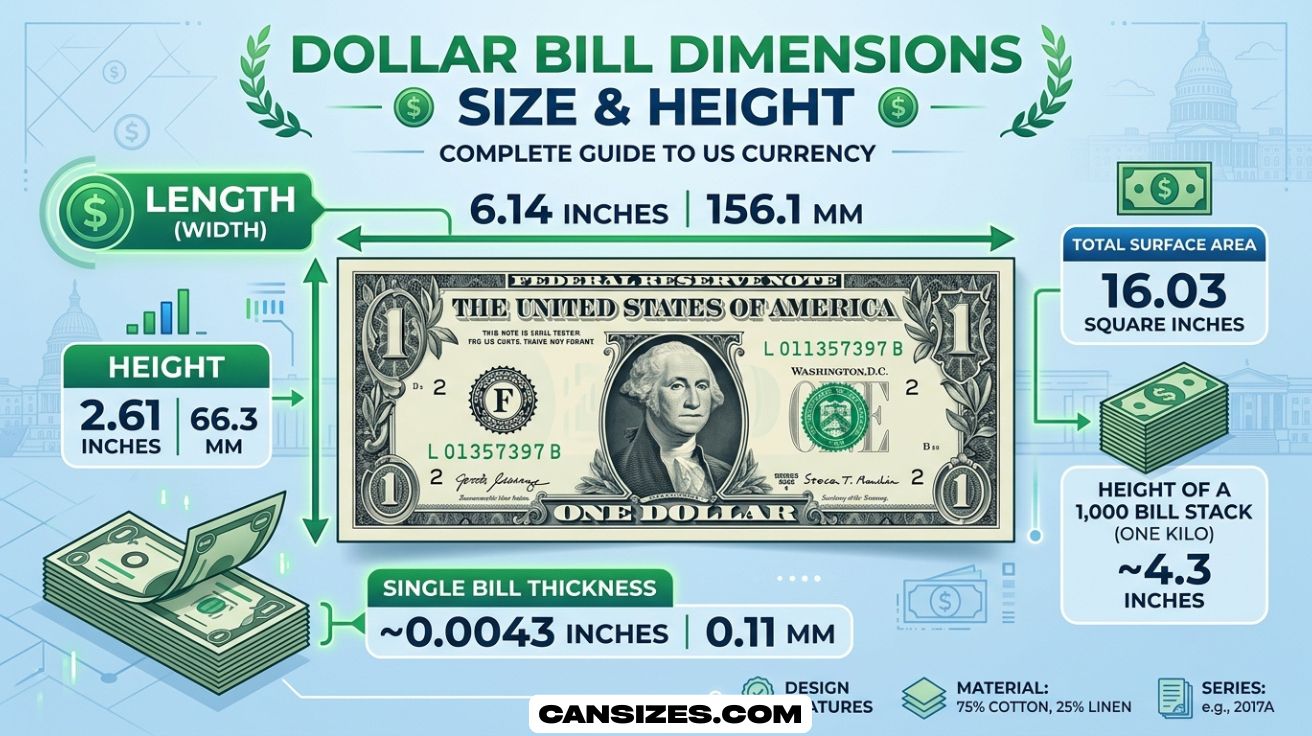
The standard dollar bill measures 6.14 inches long and 2.61 inches wide. Its size stays the same across different bill values. This makes counting, printing, and handling money easier.
Dollar Bill Dimensions in Different Units
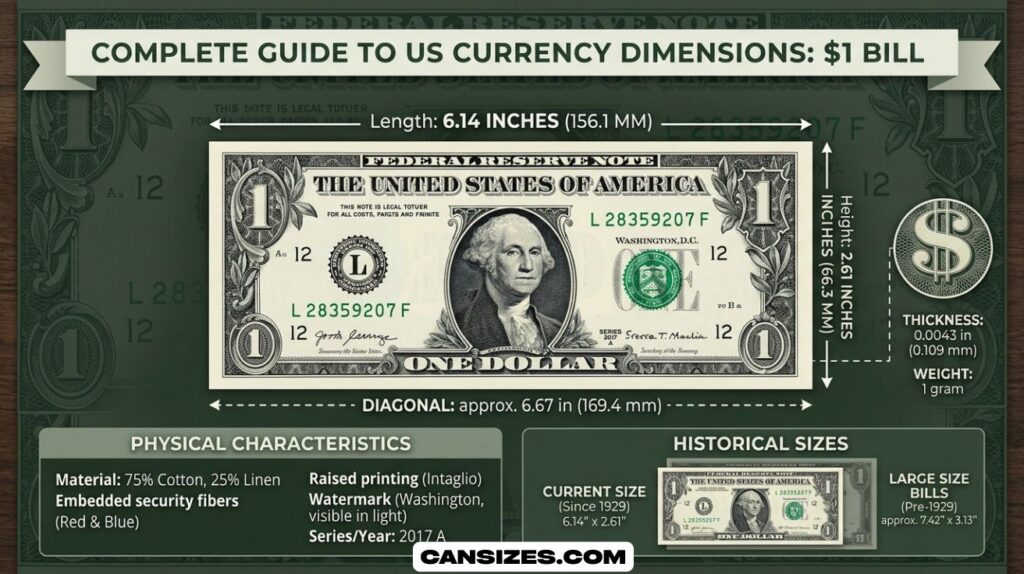
The official dollar bill dimensions are the same for every denomination in the United States. The US currency measurements in cm and inches are standardized so that machines and wallets do not need to adjust for different bill sizes.
The dollar bill length and width are fixed at 6.14 inches by 2.61 inches, which equals about 15.6 cm by 6.6 cm. This makes the US banknote size slightly longer than a credit card but much thinner and more flexible.
When people ask “what is the dollar bill size in inches”, the answer remains constant regardless of denomination. The standard dollar bill size does not change for $1, $5, $10, or $100 notes. This is one of the most unique features of American money dimensions, as many countries use different sizes for different values.
The thickness is also extremely small, but it becomes meaningful when stacked. A single bill is only about 0.11 mm thick, which is thinner than a sheet of regular printer paper.
Quick Reference Table
| Feature | Inches | Millimeters | Centimeters |
| Length | 6.14 in | 156 mm | 15.6 cm |
| Width | 2.61 in | 66.3 mm | 6.6 cm |
| Thickness | 0.0043 in | 0.11 mm | — |
| Weight | ~1 gram | — | — |
This table represents the official US currency size used by the Federal Reserve system. These values define the entire structure of Federal Reserve banknotes size used in circulation today.
Are All Dollar Bill Dimensions the Same?
Yes, all U.S. currency shares the same physical size. Whether it is a one-dollar bill or a hundred-dollar bill, the US currency standard size remains identical. This is one of the most efficient systems in global banking.
The idea behind this was to support ATM compatible currency size and ensure that machines could process all bills without adjustment. It also helps with vending machine currency compatibility, meaning a vending machine does not need to recognize different physical shapes.
This uniform system is part of modern currency design standardization, which simplifies printing, storage, and handling. Banks can stack, bundle, and count money faster because all notes match the same size.
One Size Fits All U.S. Currency
Every denomination in the United States follows the same measurement system. This includes:
The $1 bill size, $5 bill, $10 bill, $20 bill, $50 bill, and $100 bill, all sharing identical dimensions. The only differences are in color, design, and security features.
This makes the US paper money dimensions extremely practical compared to countries where each denomination has a different size. The uniform approach also improves machine reading and reduces printing complexity.
Historical Dollar Bill Sizes
Before 1929, the United States used what is known as pre-1929 currency size, which was significantly larger. These older notes were often called horse blanket currency because they were big enough to feel bulky in wallets and pockets.
The earlier system was less efficient. It required more storage space and higher production costs. After 1929, the United States shifted to the modern US currency size, reducing both cost and physical bulk.
This change marked a major milestone in the history of US dollar bills. It improved durability, allowed better handling, and created the standardized system used today.
Dollar Bill Dimensions by Denomination
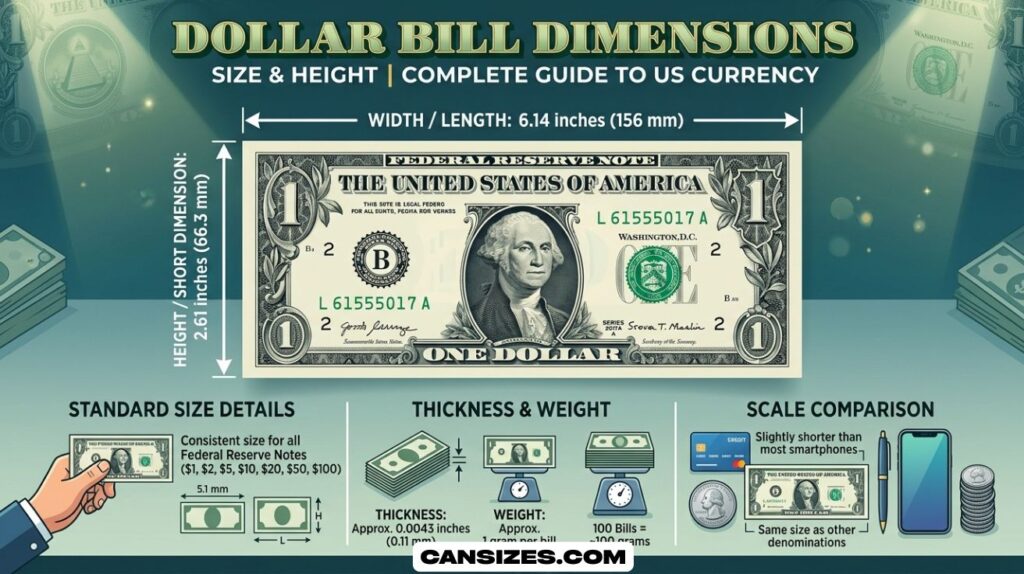
Although many people assume different bills might have different sizes, the truth is simple. All denominations share the same physical measurements. The difference lies in design and security elements, not in size.
This consistency makes it easier to manage currency in banks, ATMs, and global financial systems. The difference between denominations US bills is mainly visual and functional, not physical.
Common Denominations
The most commonly used bills in circulation include the $1 bill, $5 bill, $10 bill, $20 bill, $50 bill, and $100 bill. Each one is part of the same US banknote size system.
The $1 bill size remains the foundation of all design comparisons. The $20 bill is the most widely used in daily transactions, especially in ATMs. The $100 bill is often used for savings and larger payments but still follows the same physical format.
Even though designs differ, all of them follow identical American money dimensions, ensuring seamless compatibility in all financial systems.
Rare and Discontinued Bills
The United States once printed higher denomination bills such as $500, $1,000, $5,000, and $10,000 notes. These are no longer in circulation but remain part of financial history.
These notes still followed the same US currency size, even though their value was much higher. The government discontinued them in 1969 to reduce misuse in illegal financial activities.
The $2 bill still exists today, but it is rarely seen in circulation, making many people mistakenly believe it is discontinued. However, it is still legal tender.
Dollar Bill Thickness and Stack Height
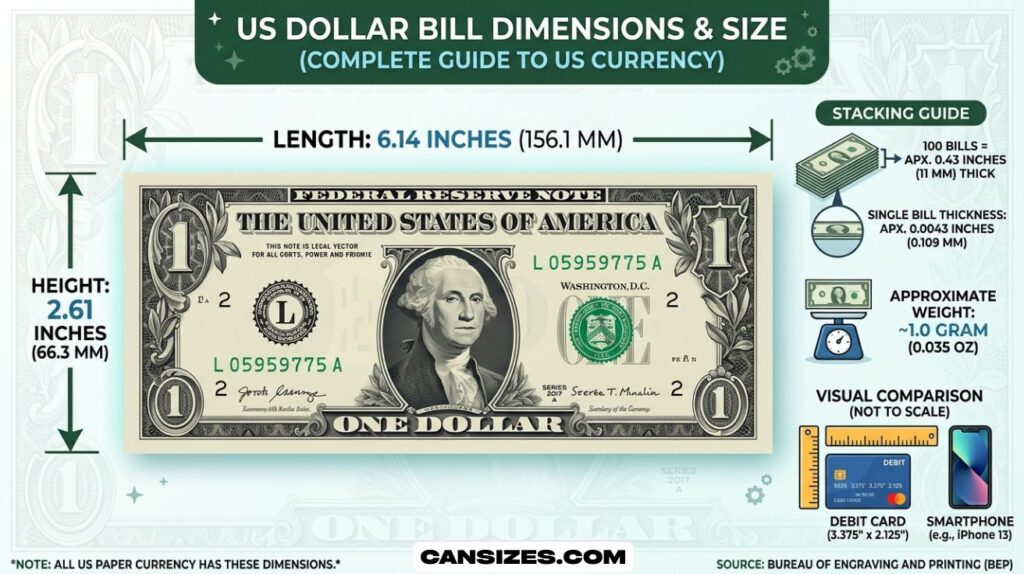
The physical thickness of money is often overlooked, but it becomes very important when dealing with large quantities. The thickness of a dollar bill is extremely small, yet it plays a big role in determining storage space and cash handling.
How Thick Is a Dollar Bill?
A single bill is approximately 0.0043 inches thick. This is made possible by the unique cotton linen paper money used in the United States. Unlike regular paper, this material is durable and long-lasting.
This special blend allows bills to survive thousands of folds without breaking easily. It also contributes to the long lifespan of U.S. currency compared to regular printed paper.
The weight of US banknotes is also very light, with each bill weighing about 1 gram. This means even large amounts of money remain surprisingly easy to carry.
Stack Calculations
When bills are stacked, their thickness becomes more noticeable. A stack of 10 bills is almost flat, but 100 bills form a small bundle about half an inch thick.
A stack of $1,000 in $1 bills reaches about 4.3 inches in height. This shows how quickly physical space increases with volume. When discussing stack of dollar bills height, the numbers become even more surprising at larger scales.
For example, $10,000 in $100 bills is much smaller than the same amount in $1 bills, showing the efficiency of higher denominations in reducing physical bulk.
A $1 million stack in $1 bills can reach over 350 feet tall, which is higher than many buildings. This is one of the most interesting examples of banknote measurements comparison in real life.
Why Dollar Bill Dimensions Matter
The fixed size of U.S. currency is not just about tradition. It supports global banking systems, ATM networks, and financial security standards. The consistent US currency size ensures that machines worldwide can recognize and process American money without errors.
It also improves security features, including watermarks, security threads, and color-shifting ink, which are part of modern US dollar security features.
Globally, different countries use different international paper money sizes, but the United States remains one of the few countries using a single uniform size for all denominations.
Why the US Uses a Fixed Dollar Bill Size System
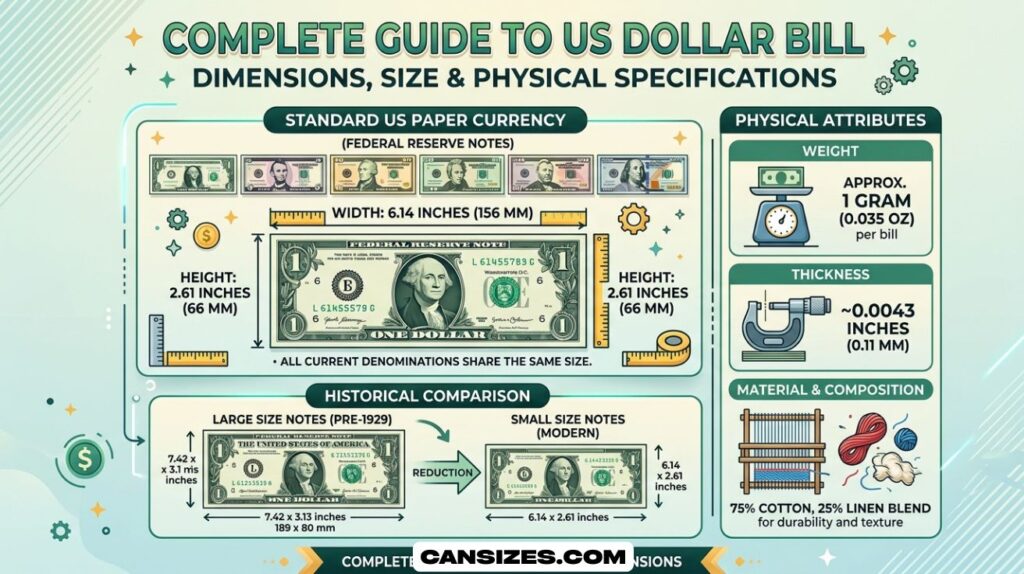
The United States uses a fixed US currency size to keep banking systems simple and efficient. With a single standard dollar bill size, ATMs, vending machines, and cash counters can process money without needing adjustments. This system reduces errors, lowers production costs, and ensures smooth handling across all financial institutions in the country.
A uniform US banknote size also improves storage and transportation. Banks can stack, bundle, and package cash quickly without sorting by size. This consistency is part of modern currency design standardization, making the entire cash system more reliable and easier to manage in both local and international financial operations.
Comparison of Dollar Bill Size With Credit Cards
The size of a dollar bill is slightly larger than a standard credit card. While a dollar bill measures 6.14 by 2.61 inches, a credit card follows ISO standards of 3.37 by 2.125 inches. This difference helps users quickly distinguish cash from plastic cards in wallets.
Even though both are used for payments, the US currency size is designed for flexibility and folding, while credit cards are rigid for machine scanning. This contrast shows how American money dimensions are optimized for physical handling, while cards focus on digital transaction efficiency and durability.
See Also : Beverage Can Dimensions Size, Height (Complete USA Guide)
How Dollar Bill Dimensions Affect Wallet Design
Wallets in the United States are specifically designed around dollar bill dimensions. Since the US paper money dimensions are fixed, wallet manufacturers can create standardized slots that perfectly fit cash. This ensures bills do not bend excessively, tear, or stick out when carried in pockets.
The consistent US currency standard size also allows global wallet brands to follow one design rule. Whether it is leather wallets or minimalist card holders, all are shaped to accommodate the same dollar bill size in inches, making everyday cash storage simple and practical.
Security Features Linked to Dollar Bill Size
The fixed US currency size allows designers to place security features in precise locations. Each bill includes watermarks, security threads, microprinting, and color-shifting ink. These features depend on exact US banknote size measurements to remain aligned and machine-readable.
Because all bills share the same dimensions, security systems can scan every denomination using one setup. This improves counterfeit detection. The uniform Federal Reserve banknotes size also ensures that machines worldwide can verify authenticity without recalibration for different bill sizes.
Lifespan and Durability of US Dollar Bills
The thickness of a dollar bill may be small, but its durability is strong due to cotton linen paper money composition. On average, a bill lasts 5 to 7 years in circulation, depending on usage. This makes it more durable than regular printed paper used in books or office documents.
The durability of US banknotes size design also supports repeated folding and handling. Even after thousands of uses, the structure remains intact. This strength ensures that US currency measurements in cm remain consistent over time despite physical wear and tear.
Stack of Dollar Bills Height in Real Life
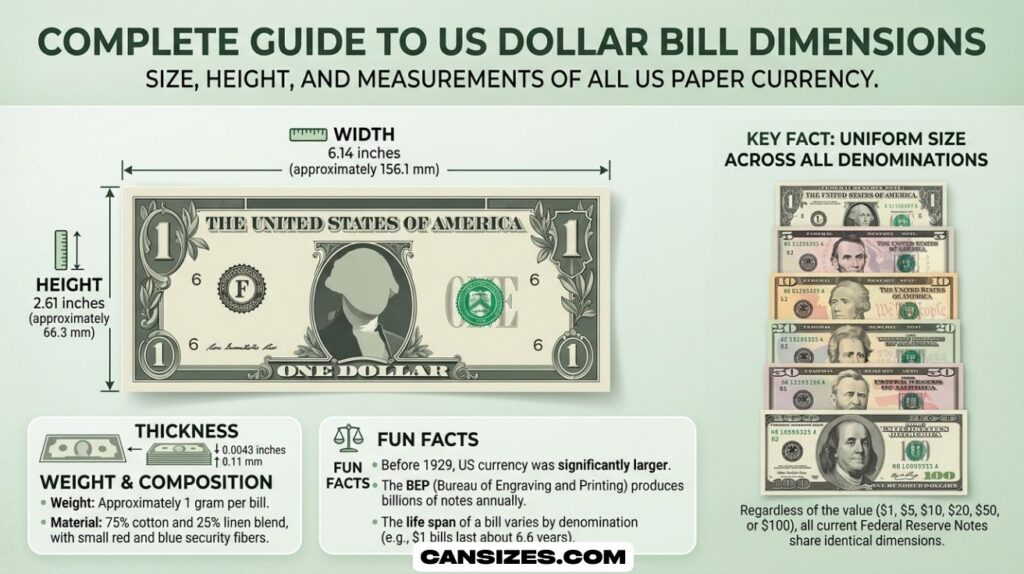
Understanding stack of dollar bills height helps visualize large amounts of money. A stack of 100 bills is about half an inch thick, while 1,000 bills reach several inches. This makes cash storage space an important factor in banks and businesses handling large volumes.
When scaled to larger amounts, the height becomes surprising. A million dollars in $1 bills forms a stack taller than many buildings. This shows how US currency size directly affects physical storage, even though digital banking has reduced reliance on cash stacking.
See Also : Pringles Can Dimensions Size Height: Exact Measurements
International Comparison of Paper Money Sizes
Different countries use different international paper money sizes, unlike the US system. Many nations assign unique sizes to each denomination to help visually identify value. This contrasts with the uniform US currency standard size, which keeps all bills identical regardless of value.
This difference affects usability. While varying sizes improve accessibility, the US system prioritizes machine efficiency. The US currency size supports faster ATM processing and simplified cash handling, making it one of the most efficient systems in global financial infrastructure.
FAQs
How thick is a $20 bill?
A $20 bill is about 0.0043 inches (0.11 mm) thick, the same as all U.S. dollar bills.
What is the height of a dollar bill?
A dollar bill is 2.61 inches (6.63 cm) tall, which is the standard fixed height for all U.S. currency.
Is a dollar bill 7 inches?
No, a dollar bill is about 6.14 inches long, so it is shorter than 7 inches.
How tall are 100 $1 bills?
100 one-dollar bills stacked together measure about 0.43 inches (1.1 cm) in height.
Final Thoughts on Dollar Bill Dimensions Size, Height
The Dollar Bill Dimensions Size, Height system reflects more than just measurements. It represents efficiency, history, and global financial design. From the old horse blanket currency to today’s compact format, U.S. money has evolved into a highly standardized system.
The consistent US currency standard size simplifies banking, reduces production costs, and ensures compatibility with machines worldwide. Whether you are measuring a single bill or calculating a million-dollar stack, the system remains simple and reliable.
In the end, the size of a dollar bill is not just a number—it is a carefully engineered standard that supports one of the largest financial systems in the world.