21 Things That Measure 100 Feet In Length
Measure 100 Feet means finding or understanding a distance that is 100 feet long in real life. It equals 30.48 meters or 1,200 inches in measurement. People use this length in construction, sports fields, roads, and building projects every day.
Many people find large measurements hard to imagine without a ruler or tape measure. Measure 100 Feet becomes easier when you compare it with seven cars, a football field section, or a ten-story building. These simple examples quickly create a clear picture in the mind.
Measure 100 Feet is useful for learning distance, space, and size in daily life. It helps in school work, travel planning, sports activities, and property measurements. Easy comparisons make this measurement simple to understand, remember, and use with confidence.
Quick Conversion
The easiest way to understand 100 feet is by converting it into familiar units used in the USA and metric system. These conversions help with 100 feet comparison examples and are widely used in construction measurement guide and sports planning.
| Unit | Equivalent |
| Feet | 100 ft |
| Meters | 30.48 meters comparison |
| Yards | 33.33 yards in feet |
| Inches | 1,200 inches |
| Miles | 0.019 miles |
These numbers show that 100 feet distance reference objects are not small. In fact, this is a large distance often seen in buildings, fields, and roads.
How Long Is 100 Feet?
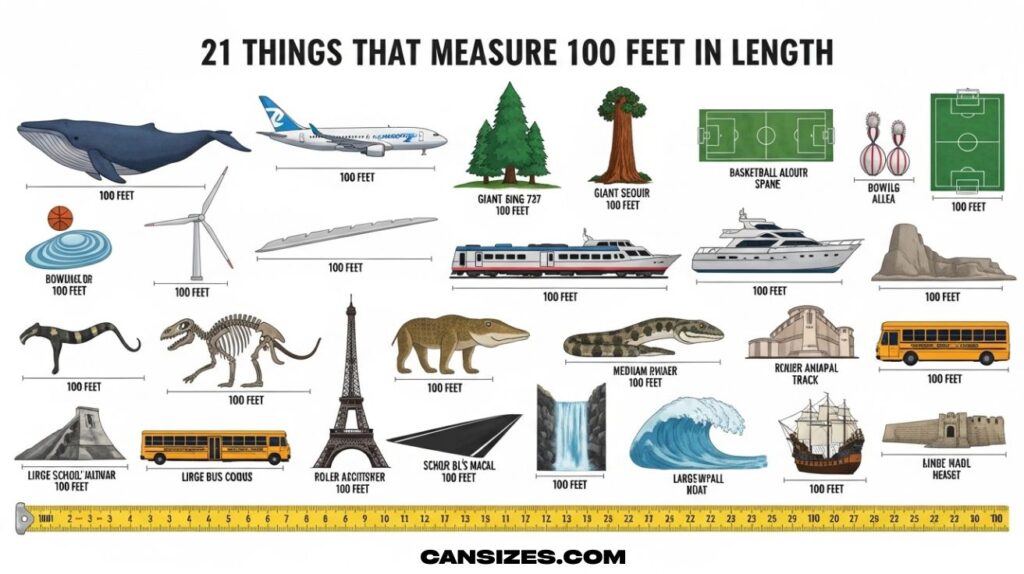
To truly understand how far is 100 feet walking, think of it in human scale. The average person walks 100 feet in about 33 to 40 seconds at normal speed. That makes it a noticeable but not overwhelming distance.
If we use human height comparison feet, the average adult is about 5.5 to 6 feet tall. That means around 16 to 18 adults lying head-to-toe equal 100 feet.
Experts in architectural scale comparison often explain it like this:
“100 feet is long enough to feel significant, but short enough to walk comfortably in less than a minute.”
This makes it easier for beginners to understand 100 feet visual estimation guide without tools.
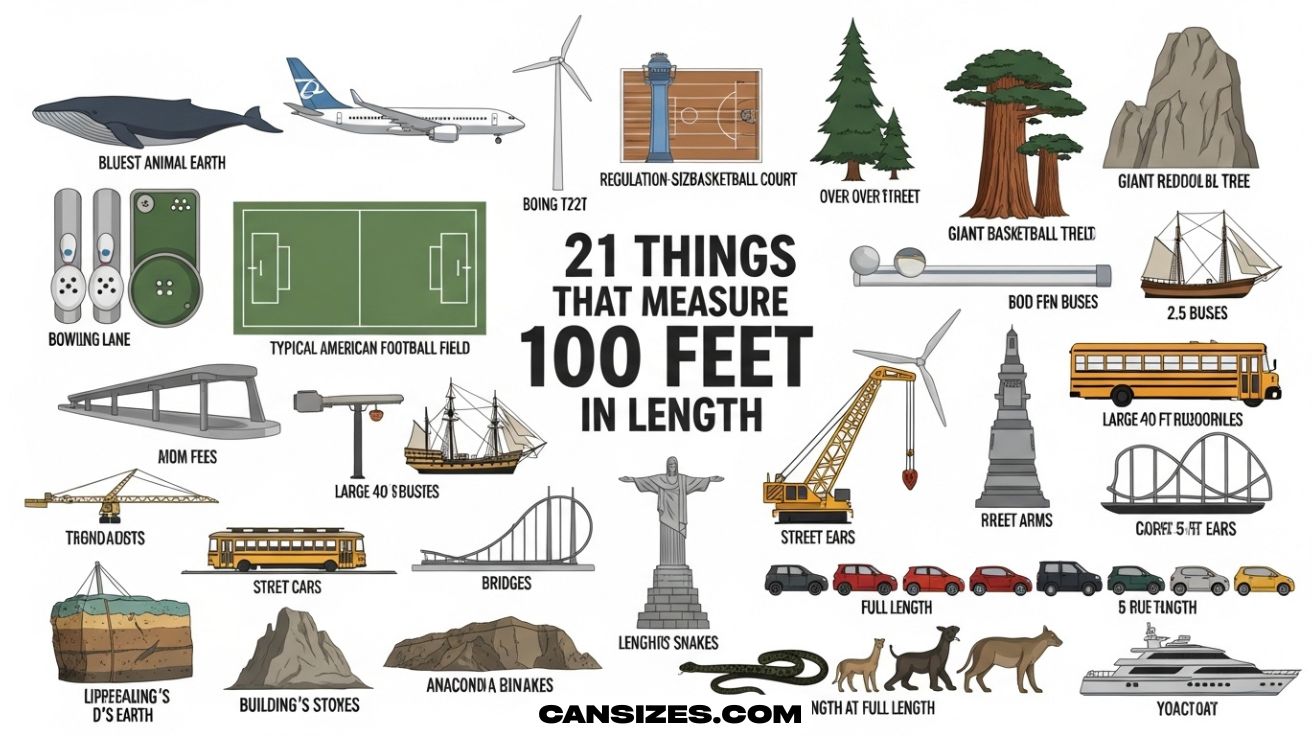
Things That Measure 100 Feet In Length
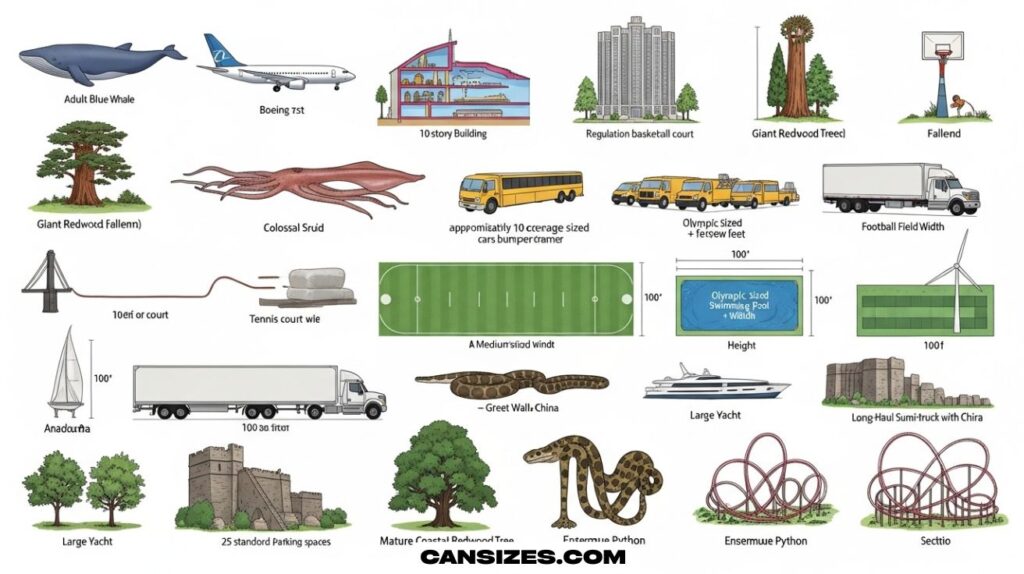
Now let’s explore things that are 100 feet long in real life. These real life objects that are 100 feet help you understand scale in a practical way.
Standard School Bus (Plus Small Car)
A school bus is about 35–40 feet long, and when combined with a small car, the total space increases significantly. Two buses together nearly reach 100 feet, making it a clear transportation-based visual example.
This helps in understanding how long is 100 feet in real life. It is a practical way of visualizing 100 feet in real life using everyday vehicles found on USA roads and school routes.
One-Third of a Football Field
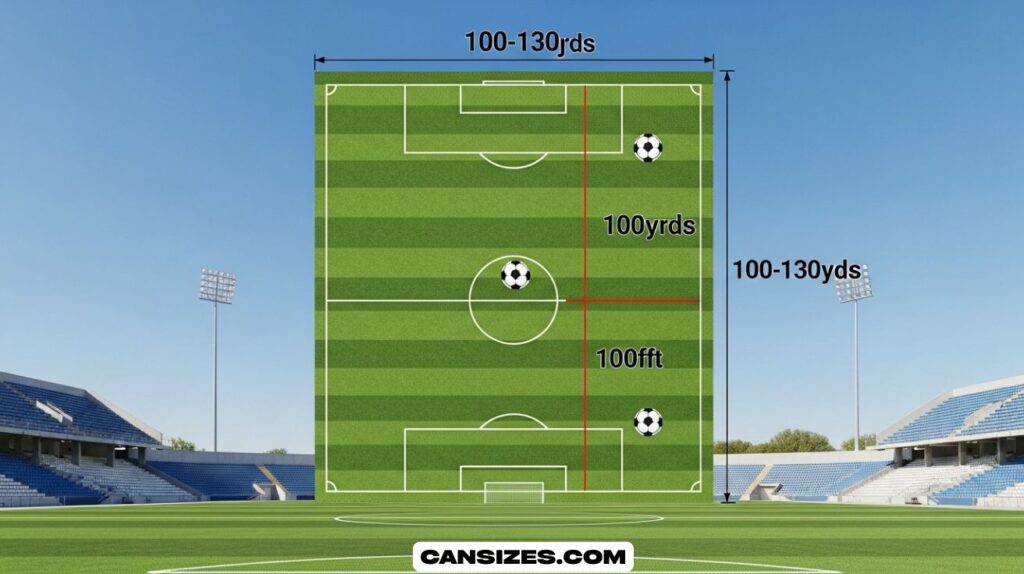
A full American football field is 300 feet long from end to end. One-third of that distance equals 100 feet, making it a perfect sports-based reference for understanding field dimensions and player movement spacing.
This is one of the easiest 100 feet comparison examples in sports. It clearly shows football field one third length and helps fans understand real game distances during matches and training sessions.
Ten-Story Building
A ten-story building is commonly around 100 feet tall, since each floor is approximately 10 feet high. This makes it a strong architectural example used in urban planning and city skyline design.
This is a key urban building height reference that explains ten story building height feet in simple terms. It helps people understand large vertical scale in cities and construction projects.
Seven Average Cars (End-to-End)
The average car is about 14–16 feet long, so placing seven cars in a straight line creates nearly 100 feet. This is a common parking lot and traffic visualization method.
This example clearly shows 100 feet equivalent in cars or buildings. It is widely used in car length average feet estimation and helps drivers quickly judge road or parking space distance.
Mature Oak or Pine Tree
Many mature oak and pine trees grow between 80 and 120 feet tall, making them natural examples of 100 feet height in forests, parks, and rural landscapes across the United States.
This is a powerful mature tree height feet example that supports real life objects that are 100 feet. It gives a natural sense of scale and environmental understanding for learners.
Semi-Truck and Full Trailer
A semi-truck with trailer typically measures around 70–80 feet in total length. Some extended freight vehicles can approach or slightly exceed 100 feet on highways and industrial transport routes.
This is a useful semi truck trailer length example for understanding real world measurement examples. It helps visualize large transport vehicles commonly seen on American interstates and logistics systems.
Fire Truck with Ladder Extended
Fire truck ladders can extend up to 100 feet to reach upper floors of tall buildings during emergencies. This makes them one of the most precise real-world 100-foot tools used in safety operations.
This is a direct 100 feet height example in emergency services. It clearly demonstrates how far is 100 feet walking when converted into vertical rescue distance and firefighting operations.
18 Adults (Head-to-Toe)
An average adult is about 5.5 to 6 feet tall, so lining up 16 to 18 people head-to-toe creates a total length close to 100 feet in a straight line.
This simple human-based method helps explain human height comparison feet. It is a clear and relatable way of 100 feet measurement explained simply in classrooms and demonstrations.
Three-Lane Swimming Pool (Length)
A standard lap pool is often around 75 feet, while larger training pools can extend close to 100 feet when lanes and deck space are included. This makes swimming facilities a strong real-world reference for length estimation.
This example helps explain how long is 100 feet using sports environments. It supports visualizing 100 feet in real life for athletes and swimmers who regularly experience pool distances during training sessions.
Basketball Court (Slightly Longer)
A professional basketball court is 94 feet long, which is very close to 100 feet. Adding just a few extra steps beyond the baseline completes the full 100-foot measurement in a simple visual comparison.
This is one of the best 100 feet comparison examples in sports. It clearly shows basketball court length feet and helps players understand sports field dimensions guide through familiar indoor arenas.
Tennis Court (Three Times Length)
A tennis court is 78 feet long, so adding extra surrounding space or imagining multiple courts gives a near 100-foot distance. It is often used in sports training for spatial awareness and movement drills.
This helps explain tennis court dimensions feet in real settings. It improves visual scale estimation chart understanding by connecting court size to real-world 100 feet distance reference objects used in athletics.
Large Yacht or Small Ship
Many luxury yachts range between 80 and 120 feet in length, making a 100-foot yacht a common mid-size vessel. These boats are used for private travel, tourism, and ocean cruising in coastal waters.
This is a strong example of real life objects that are 100 feet. It helps readers understand large distance understanding guide in marine environments and real-world luxury transportation systems.
Small Apartment Building
Small residential apartment buildings often measure close to 100 feet in height or width depending on design. These structures are common in urban USA neighborhoods and provide housing for multiple families.
This supports urban building height reference and explains construction measurement guide in real estate planning. It gives a practical idea of architectural scale comparison used in city development and housing layouts.
Seven Standard Cars Bumper-to-Bumper
When seven average sedans are parked end-to-end, they create a straight line close to 100 feet. This is one of the simplest and most commonly used real-world visual estimations in everyday life.
This example clearly shows car length average feet in action. It improves understanding of 100 feet equivalent in cars or buildings and is widely used in parking, driving, and road space planning.
100 Feet Without Measuring
Sometimes you need to estimate distance without tools. Here are easy ways used in 100 feet visual estimation guide systems.
Ten-Story Building Height
A building with 10 floors is close to 100 feet tall. This is a simple way to judge height in cities using urban building height reference.
One-Third of a Football Field
From one goal line to the 33-yard line is exactly 100 feet. This is widely used in sports field dimensions guide training.
Seven Standard Cars Bumper-to-Bumper
Parking seven cars in a line gives a quick estimate of 100 feet. This is a common visual scale estimation chart method.
33–40 Seconds of Normal Walking
At normal speed, walking 100 feet takes about 33–40 seconds. This is one of the easiest walking distance estimation techniques.
100 Feet Matters in Everyday Life
Understanding how long is 100 feet is important in many areas of life. In construction, it helps engineers plan safe building distances. In real estate, it defines property size and layout.
In sports, knowing what does 100 feet look like improves performance tracking and field awareness. In transportation, it helps design roads, parking areas, and loading zones.
In safety systems, 100 feet is often used for fire codes and emergency clearance rules. This shows why 100 feet distance reference objects are important in daily USA life.
100 Feet in City Streets and Urban Spaces
In city environments, 100 feet often appears as the width of small blocks, parking lots, or building setbacks. When walking through downtown areas in the USA, you may pass this distance without realizing it. It helps planners design roads, sidewalks, and safe gaps between buildings for traffic flow and pedestrian movement.
Urban designers rely on 100 feet for zoning rules and infrastructure planning. It ensures buildings have proper spacing for light, air, and safety. This distance also helps in organizing street layouts, parking zones, and emergency access routes, making cities more structured, safe, and easy to navigate for residents.
100 Feet in Construction and Engineering Projects
In construction, 100 feet is a key reference used for measuring plots, building height limits, and site planning. Engineers often use it to visualize scale before starting a project. It helps in placing foundations, designing layouts, and ensuring structures meet safety and design standards in residential and commercial projects.
Surveyors frequently use 100 feet as a basic measurement unit in fieldwork. It helps them map land accurately and plan infrastructure like roads and pipelines. This distance is also important in blueprint design, ensuring all parts of a construction project fit together properly within defined spatial limits.
100 Feet in School and Educational Examples
Schools use 100 feet as a teaching tool to explain measurement concepts in a simple way. Students can understand distance better by comparing it with hallways, playgrounds, or gym spaces. It makes math and science lessons easier when real-life examples are used instead of abstract numbers alone.
Teachers often demonstrate 100 feet using walking exercises or classroom layouts. This helps students learn spatial awareness and estimation skills. It also improves understanding of geometry and measurement units, making learning more interactive, practical, and connected to everyday life experiences inside and outside the classroom environment.
100 Feet in Sports Training and Practice
Athletes often experience 100 feet during training drills, sprint exercises, and field positioning. Coaches use this distance to improve speed, endurance, and spatial awareness. It helps players understand how far they move during a game and how to manage energy across different sections of a field.
In many sports, 100 feet is used to set practice zones or drill boundaries. It allows teams to simulate real game conditions. This distance also helps in improving coordination, timing, and accuracy, especially in sports like football, baseball, and track and field training sessions.
100 Feet in Transportation and Road Design
Transportation systems rely on 100 feet for designing safe distances between vehicles, intersections, and traffic signals. Engineers use it to plan stopping zones, lane spacing, and parking layouts. It helps ensure smooth movement of cars, trucks, and emergency vehicles on busy roads and highways.
This measurement is also important for truck trailers, bus stops, and loading zones. It ensures large vehicles have enough space to move safely without causing traffic problems. Road planners use 100 feet as a standard reference for visibility and safety design in urban and rural areas.
100 Feet in Nature and Environmental Studies

In nature, 100 feet is often seen in tall trees, cliffs, and waterfalls. Many mature forest trees naturally grow to this height, giving scientists a way to study ecosystems. It helps in understanding how plants compete for sunlight and space in dense forest environments.
Environmental researchers use 100 feet to measure natural growth and landscape scale. It helps them track forest health and biodiversity. This distance also appears in mountainsides and coastal areas, showing how large and powerful natural formations can be when compared to human-made structures.
100 Feet in Daily Life Estimation Skills
Learning to estimate 100 feet helps improve everyday decision-making. People use it when arranging furniture, measuring yards, or planning outdoor events. It builds a better sense of space, making it easier to judge distances without needing tools or measuring devices in simple situations.
This skill is also useful when walking, driving, or organizing spaces. By practicing estimation, people develop stronger spatial awareness. It helps in real-world tasks like parking, gardening, and home design, making daily activities more efficient and accurate without relying on exact measurements every time.
FAQs
How big is a room that’s 100 feet?
A room that is 100 feet long is very large, similar to a warehouse, gym, or big event hall.
It can easily hold rows of cars, large equipment, or multiple office sections inside.
Can I measure feet by walking?
Yes, you can estimate feet by walking because an average step is about 2.5 to 3 feet long.
Walking 100 feet usually takes around 33–40 normal steps depending on your stride.
What is an example of 100 linear feet?
An example of 100 linear feet is about 7 average cars parked in a straight line.
It can also be the length of a long fence, driveway, or building side.
How many stories tall is 100 feet?
100 feet is roughly equal to a 10-story building in standard construction.
Each floor is usually about 10 feet tall including structure and ceiling space.
Conclusion
Understanding how to Measure 100 Feet becomes simple when you connect it with real-life examples like cars, buildings, and sports fields. A distance of 100 feet is not small, but it is also not too large to imagine. It is close to the length of seven cars parked in a line or the height of a ten-story building. These simple comparisons help you build a clear picture in your mind and improve your sense of space in daily life.
When you learn to Measure 100 Feet, you improve your ability to judge distance without tools. This skill helps in school, travel, sports, and construction work. You can estimate walking distance, room size, and outdoor spaces with more confidence. Simple practice makes this understanding stronger, and you can use it in many real situations. This knowledge supports better learning and makes everyday measurement easier and more accurate.